100 Basic English Words for Beginners: Daily Vocabulary List
Essential vocabulary for English learners. Master 100 basic English words to build a strong foundation for speaking and understanding English.
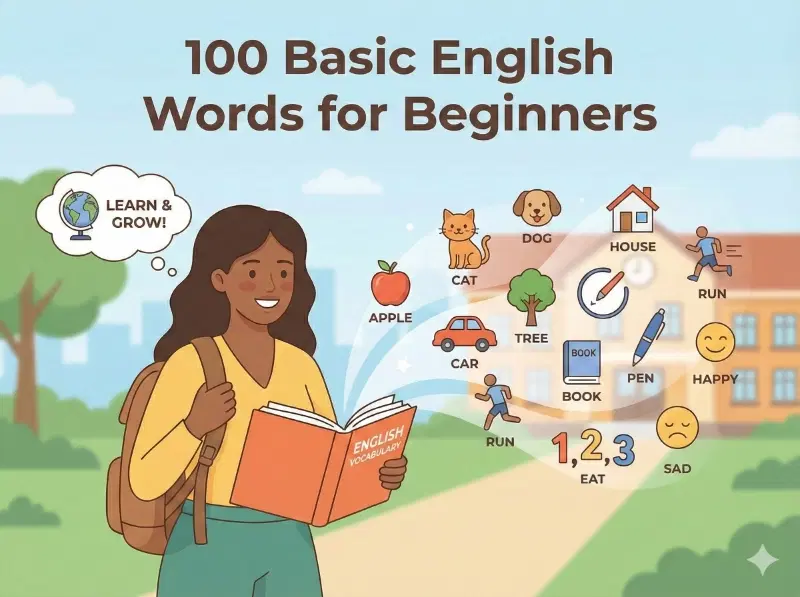
Learning English starts with mastering the most common words you'll use every day. This comprehensive guide presents 100 essential English words that every beginner (A1 level) should know, organized by category for easy learning.
Before diving into the strategies, here's a good tip: Bhasha.io offers highly-rated English speaking courses where you can learn English online with expert trainers. Our structured program can accelerate your English language learning journey significantly.
Why These 100 Words Matter
These basic English words form the foundation of everyday communication. Studies show that the 100 most common English words make up approximately 50% of all written material. Master these, and you'll understand half of what you read and hear!
Personal Pronouns (8 Words)
Understanding pronouns is your first step to forming English sentences.
| English Word | Pronunciation | Example Sentence |
|---|---|---|
| I | /aɪ/ | I am a student. |
| You | /juː/ | You are my friend. |
| He | /hiː/ | He is tall. |
| She | /ʃiː/ | She is kind. |
| It | /ɪt/ | It is a cat. |
| We | /wiː/ | We are happy. |
| They | /ðeɪ/ | They are teachers. |
| This | /ðɪs/ | This is my book. |
💡 Tip: Practice pronouns by pointing at people and things around you. Say "I am [your name]", "This is [object]", "He/She is [person]."
Essential Verbs (20 Words)
These action words help you describe what you do every day.
| English Word | Pronunciation | Meaning | Example |
|---|---|---|---|
| Be | /biː/ | to exist | I am happy. |
| Have | /hæv/ | to possess | I have a car. |
| Do | /duː/ | to perform | I do my homework. |
| Go | /ɡoʊ/ | to move | I go to school. |
| Come | /kʌm/ | to arrive | Please come here. |
| See | /siː/ | to view | I see a bird. |
| Know | /noʊ/ | to understand | I know English. |
| Get | /ɡet/ | to obtain | I get up at 7 AM. |
| Make | /meɪk/ | to create | I make breakfast. |
| Say | /seɪ/ | to speak | I say hello. |
| Think | /θɪŋk/ | to believe | I think it's good. |
| Take | /teɪk/ | to grab | Take this pen. |
| Want | /wɑːnt/ | to desire | I want water. |
| Give | /ɡɪv/ | to provide | Give me the book. |
| Use | /juːz/ | to utilize | I use a phone. |
| Work | /wɜːrk/ | to labor | I work every day. |
| Like | /laɪk/ | to enjoy | I like pizza. |
| Eat | /iːt/ | to consume food | I eat lunch. |
| Drink | /drɪŋk/ | to consume liquid | I drink coffee. |
| Sleep | /sliːp/ | to rest | I sleep 8 hours. |
💡 Tip: Learn verbs in groups by daily routine: wake up → get up → eat → go → work → come → eat → sleep.
Common Nouns (25 Words)
People & Family
| English Word | Pronunciation | Example |
|---|---|---|
| Man | /mæn/ | The man is tall. |
| Woman | /ˈwʊmən/ | The woman is kind. |
| Person | /ˈpɜːrsən/ | A person is here. |
| Child | /tʃaɪld/ | The child is playing. |
| Friend | /frend/ | My friend is nice. |
| Family | /ˈfæməli/ | My family is big. |
| Mother | /ˈmʌðər/ | My mother cooks well. |
| Father | /ˈfɑːðər/ | My father works hard. |
Things & Places
| English Word | Pronunciation | Example |
|---|---|---|
| House | /haʊs/ | My house is small. |
| School | /skuːl/ | I go to school. |
| Book | /bʊk/ | This book is good. |
| Water | /ˈwɔːtər/ | I drink water. |
| Food | /fuːd/ | The food is delicious. |
| Phone | /foʊn/ | My phone is new. |
| Car | /kɑːr/ | His car is red. |
| Time | /taɪm/ | What time is it? |
| Day | /deɪ/ | Have a nice day! |
| Year | /jɪr/ | This year is 2026. |
| Hand | /hænd/ | Wash your hands. |
| Eye | /aɪ/ | I have two eyes. |
| Name | /neɪm/ | My name is John. |
| Money | /ˈmʌni/ | I need money. |
| Place | /pleɪs/ | This place is nice. |
| Thing | /θɪŋ/ | What is this thing? |
| Way | /weɪ/ | Which way is home? |
💡 Tip: Label items in your home with English sticky notes to practice nouns daily!
Important Adjectives (15 Words)
Adjectives help you describe people, places, and things.
| English Word | Pronunciation | Opposite | Example |
|---|---|---|---|
| Good | /ɡʊd/ | Bad | This is good. |
| Bad | /bæd/ | Good | That is bad. |
| Big | /bɪɡ/ | Small | A big house. |
| Small | /smɔːl/ | Big | A small car. |
| New | /nuː/ | Old | A new phone. |
| Old | /oʊld/ | New | An old book. |
| Hot | /hɑːt/ | Cold | Hot coffee. |
| Cold | /koʊld/ | Hot | Cold water. |
| Happy | /ˈhæpi/ | Sad | I am happy. |
| Sad | /sæd/ | Happy | She is sad. |
| Easy | /ˈiːzi/ | Difficult | English is easy. |
| Hard | /hɑːrd/ | Easy | Math is hard. |
| Nice | /naɪs/ | Mean | You are nice. |
| Right | /raɪt/ | Wrong | That is right. |
| Wrong | /rɔːŋ/ | Right | This is wrong. |
💡 Tip: Learn adjectives in opposite pairs (hot/cold, big/small) to double your vocabulary quickly!
Question Words (6 Words)
Master these words to ask questions in English.
| English Word | Pronunciation | Use | Example |
|---|---|---|---|
| What | /wɑːt/ | Things/actions | What is your name? |
| Where | /wer/ | Places | Where are you from? |
| When | /wen/ | Time | When is your birthday? |
| Who | /huː/ | People | Who is that person? |
| Why | /waɪ/ | Reasons | Why are you sad? |
| How | /haʊ/ | Methods/condition | How are you? |
💡 Tip: Practice one question word per day. Ask yourself questions: "What is this?" "Where am I?" "When is lunch?"
Basic Prepositions (8 Words)
Prepositions show relationships between words.
| English Word | Pronunciation | Meaning | Example |
|---|---|---|---|
| In | /ɪn/ | Inside | The book is in the bag. |
| On | /ɑːn/ | Surface/top | The cup is on the table. |
| At | /æt/ | Specific point | I am at school. |
| To | /tuː/ | Direction | I go to work. |
| From | /frɑːm/ | Origin | I am from India. |
| With | /wɪð/ | Together | I live with my family. |
| For | /fɔːr/ | Purpose | This is for you. |
| Of | /ʌv/ | Belonging | A cup of tea. |
Numbers 0-10 (11 Words)
| Number | English Word | Pronunciation |
|---|---|---|
| 0 | Zero | /ˈzɪroʊ/ |
| 1 | One | /wʌn/ |
| 2 | Two | /tuː/ |
| 3 | Three | /θriː/ |
| 4 | Four | /fɔːr/ |
| 5 | Five | /faɪv/ |
| 6 | Six | /sɪks/ |
| 7 | Seven | /ˈsevən/ |
| 8 | Eight | /eɪt/ |
| 9 | Nine | /naɪn/ |
| 10 | Ten | /ten/ |
💡 Tip: Count everything! Count stairs, count items in your bag, count people in a room. Daily practice makes perfect.
Connecting Words (7 Words)
These words help you build longer sentences.
| English Word | Pronunciation | Use | Example |
|---|---|---|---|
| And | /ænd/ | Addition | I like tea and coffee. |
| But | /bʌt/ | Contrast | I'm tired but happy. |
| Or | /ɔːr/ | Choice | Tea or coffee? |
| Because | /bɪˈkɔːz/ | Reason | I'm happy because it's sunny. |
| So | /soʊ/ | Result | I'm tired, so I'll sleep. |
| Very | /ˈveri/ | Intensity | It's very cold. |
| Not | /nɑːt/ | Negation | I am not tired. |
How to Practice These 100 Words Effectively
Daily Practice Routine (15 Minutes)
- Morning (5 minutes): Review 10 words with flashcards
- Afternoon (5 minutes): Use 5 words in sentences about your day
- Evening (5 minutes): Test yourself by writing 5 words from memory
Learning Strategies
✅ Use the Spaced Repetition Method
- Day 1: Learn 10 new words
- Day 2: Review Day 1 + Learn 10 new words
- Day 3: Review Day 1 & 2 + Learn 10 new words
- Continue this pattern for all 100 words
✅ Create Personal Sentences Don't just memorize. Make sentences about YOUR life:
- ✗ "I have a book." (generic)
- ✓ "I have a blue English book on my table." (personal)
✅ Practice With Real Situations
- At the supermarket: "I want milk and bread."
- With friends: "Where do you work?"
- At home: "This food is very good."
✅ Use Multiple Senses
- See: Write the words
- Hear: Listen to pronunciations (use Google Translate or Forvo.com)
- Speak: Say each word 5 times
- Touch: Use physical flashcards
Common Mistakes to Avoid
| ❌ Wrong | ✅ Correct | Explanation |
|---|---|---|
| I am go to school | I go to school | Don't use "am" with action verbs |
| He are happy | He is happy | Use "is" with he/she/it |
| This is very good thing | This is a very good thing | Add "a" before singular countable nouns |
| I have 25 years | I am 25 years old | Use "am" for age |
| I like very much pizza | I like pizza very much | Place "very much" after the object |
💡 Tip: Making mistakes is NORMAL and GOOD! Every mistake is a learning opportunity.
Test Your Knowledge: Quick Quiz
Fill in the blanks with words from the list:
- _____ are you from? (Question word for place)
- I _____ to school every day. (Movement verb)
- The coffee is very _____. (Temperature adjective)
- My _____ is Sarah. (Personal identifier)
- I have _____ brothers and _____ sister. (Numbers)
Answers: 1. Where, 2. go, 3. hot/cold, 4. name, 5. two/three, one
Next Steps After Mastering These 100 Words
Once you're comfortable with these basic words, you're ready to:
- Expand to 500 words - Learn A2 level vocabulary
- Study basic grammar - Present simple, past simple tenses
- Practice conversations - Use phrases like "How are you?" "Nice to meet you"
- Read simple texts - Children's books, graded readers
- Watch English content - Kids' shows with subtitles
Frequently Asked Questions
How long does it take to learn these 100 words? With 15 minutes of daily practice, most beginners master these words in 2-3 weeks. However, everyone learns at their own pace.
Should I learn British or American English? For beginners, the differences are minimal. Choose based on your goals (where you'll use English), but don't worry too much—native speakers understand both!
Do I need to learn pronunciation symbols? Not necessarily. Use online pronunciation tools (Google Translate, Forvo, YouGlish) to hear words spoken by native speakers.
What if I forget words I've learned? This is completely normal! Review is key. Use spaced repetition and keep practicing the words in real contexts.
Can I learn all 100 words in one day? You could memorize them, but you won't remember them long-term. Slow, steady practice with review is much more effective.
Conclusion
These 100 basic English words are your foundation for English fluency. Remember:
- Practice daily - Even 10 minutes helps
- Use the words - Don't just memorize, communicate
- Be patient - Language learning takes time
- Celebrate progress - Every new word is an achievement!
Start with 10 words today. By next month, you'll be using all 100 words naturally in conversation. You can do this! 🌟



Learn Indian Languages Online with Expert Native Tutors
Bhasha.io is India's premier online language learning platform, offering personalized Hindi, Tamil, Kannada, Marathi, Telugu, Bengali, Malayalam, Gujarati, Punjabi, and English classes online. Connect with experienced native tutors, access comprehensive learning resources, and achieve fluency through our structured curriculum designed for all proficiency levels.